Current picture
See what needs attention. Use AI Baseline to explore reported concerns where useful.
WAIA brings AI Baseline, guidance, learning, and examples from real work into one view. Managers can see what changed in a workflow, how strong the evidence is, and what to review next.
WAIA connects these parts of the work. Learning participation shows who has engaged; examples from real work show what may be changing. Management reviews both before deciding what to do.
Starts, completions and certificates describe learning participation. They don’t prove workplace application, behavior change or organizational improvement. WAIA keeps those signals separate from evidence about the work.
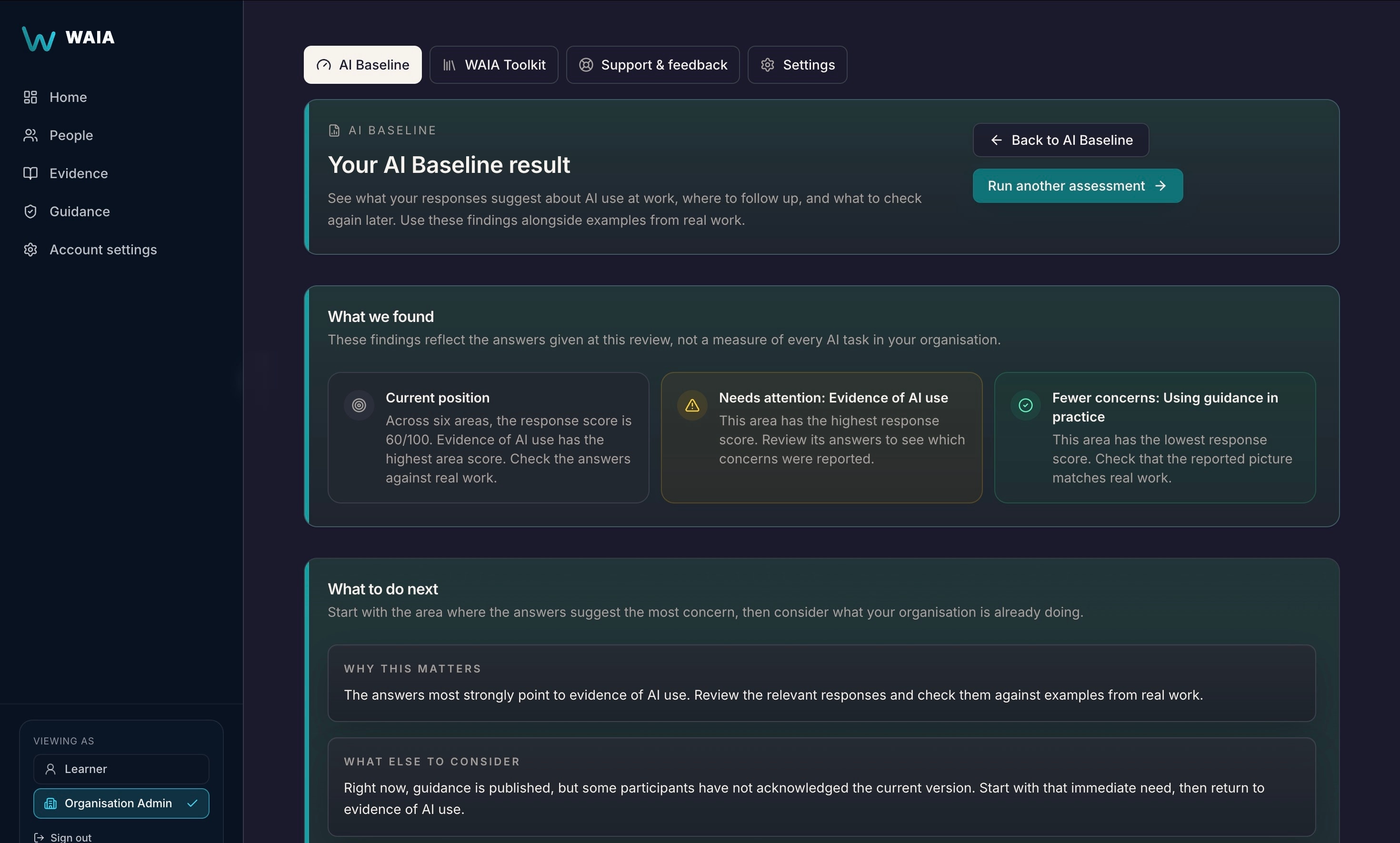
AI Baseline now leads with what the answers suggest, what to do next and what to check later.
A learner session asks people to inspect an AI recommendation, check its support and keep the final decision human.

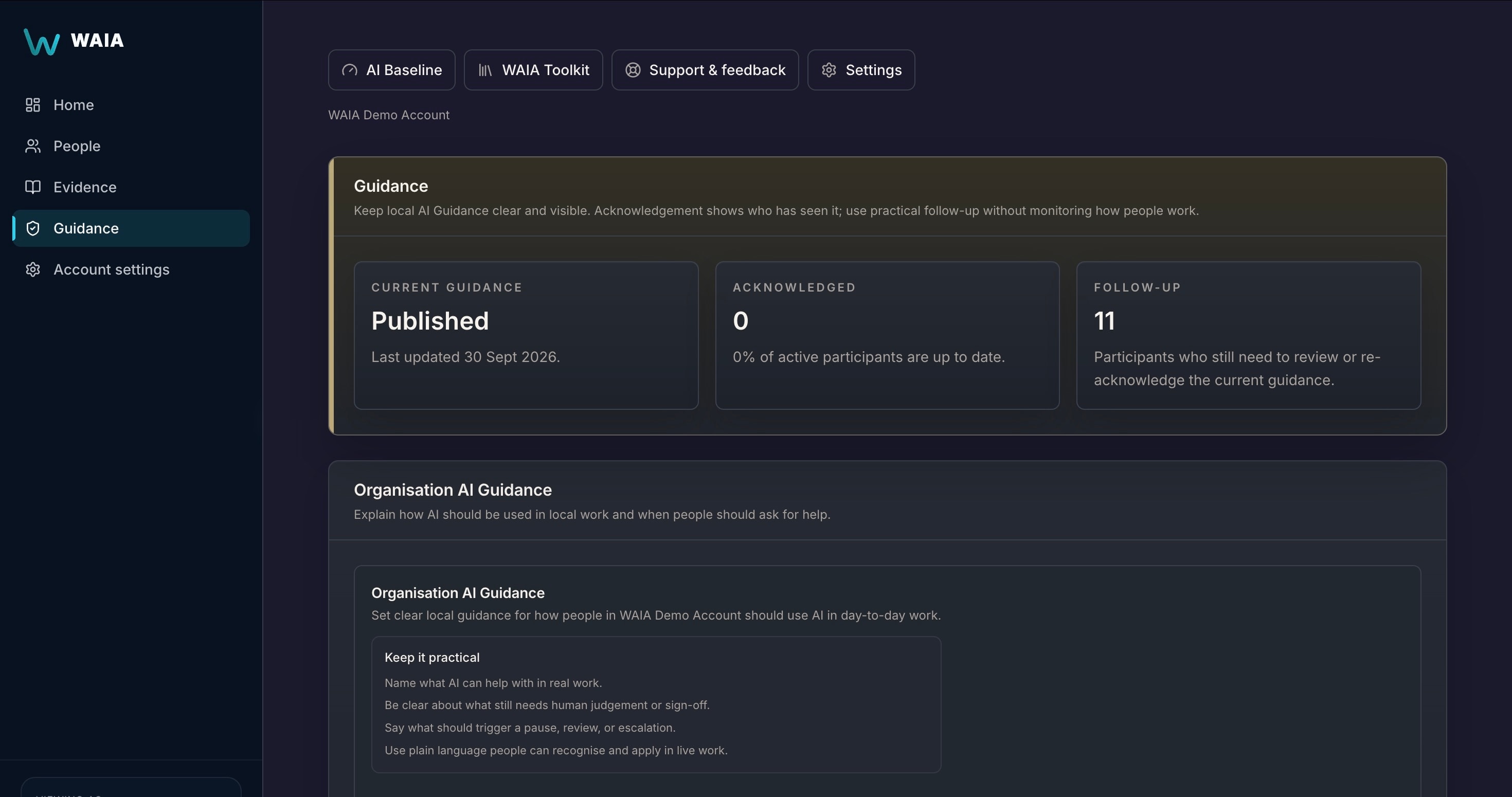
Organization guidance gives people a local reference point for responsible use.
Strong evidence can show that AI is helping or adding burden. There may also be too little evidence to decide yet.
A single structured observation can become observed. Repeated evidence needs observations across time. Validated requires accountable human management review.
WAIA doesn’t assume AI is creating value. Negative and mixed signals help management see where AI may be increasing checking, rework or risk.
Where evidence is strong enough, consistent and current, WAIA can show conservative indicative capacity ranges. Weak evidence, stale evidence, unclear outcomes or unsuitable workflow frequency can prevent calculation.
Indicative capacity released.
No material capacity change evidenced.
Indicative additional capacity required.
Capacity isn’t automatically a financial saving.
This is an illustrative scenario, not a customer case study. It shows the kind of operating question WAIA is designed to make visible.
An organization has introduced Copilot, while some teams also use ChatGPT for drafting, meeting notes and first-pass research. Usage spreads unevenly.
People record recurring workflows, frequency, net time change, checking and rework burden, outcome signal and plain workplace context.
WAIA distinguishes Reported, Observed, Repeated and Validated evidence from whether the result is positive, neutral, negative, mixed or unclear.
Stronger evidence can be grouped into organization workflows, reviewed by accountable managers and used to decide what needs investment, intervention or more evidence.
Where the evidence supports it, WAIA can show indicative capacity. Where it’s weak, mixed or stale, the product keeps that uncertainty visible.
WAIA begins with the organization's current questions, then makes Guidance, learning and evidence from real work useful for the people who need them.
Discuss current AI use, the operating concern and who needs to be involved.
Agree the eligible population, administrators, sponsor and first evidence priority.
Set the organization view, Guidance, AI Baseline and initial learning pathway.
Review reported concerns and stronger areas as a starting point for follow-up, not proof of performance.
Make practical expectations visible to the people who need to apply them.
Give the agreed people access to WAIA and appropriate learning.
Review learning participation and Guidance acknowledgment as context. Use examples from real work and evidence strength to decide the next action.
Practical workplace AI learning connected to local guidance.
A current view of workplace evidence and the follow-up that matters.
WAIA helps managers review evidence from work. The organization still owns its decisions.
WAIA doesn’t replace legal advice, regulatory advice, HR advice or compliance certification.
WAIA doesn’t replace internal governance ownership, risk decisions, management conclusions or human judgment.
WAIA isn’t enterprise GRC, technical AI model monitoring or employee surveillance. It’s also not an autonomous ROI engine.
The first conversation is used to understand the current evidence gap, the eligible population and a practical first evidence priority.